May 2026 Transparency Report
The autoclave fix held. LC-2026-002 ran on a pressure-verified cycle and three of four jars came back clean — the first live liquid culture. No cash moved all month.
1. Summary
May was a recovery month, and the recovery worked. The autoclave failure that killed all of LC-2026-001 in April was the thing to fix, and the fix held:
LC-2026-002is the first live liquid culture. Four jars on a pressure-verified cycle (15 PSI, not timer-based). Three came back clean with suspended white mycelium; one is still suspect. April lost both jars to a control that failed in the autoclave — this time the autoclave held.AGAR-2026-002corrected the pour. 10 plates, thinner pours; 9 healthy, 1 lost. April's batch was 6 of 7 — this one is 9 of 10.AGAR-2026-003is a 4-recipe media trial (T1 lean → T4 high-nitrogen) to pick the agar we standardize on. 16 plates, judged on which recipe's mycelium reaches farthest toward the edge — results still maturing, so the winner isn't called yet.
No ledger movement in May. Personal capital deployed: $0.00. Operating balance unchanged at $738.58 (₹68,305.87). No DAO treasury movements — the DAO is not yet capitalized.
2. Lab status
Four batches were registered in May (one of them, MOTHER-2026-001, is the purchased mother culture back-filled into the system so descendants link to a real unit).
| Batch | Type | Status at month-end | Started | Notes |
|---|---|---|---|---|
MOTHER-2026-001 |
Agar (mother) | 1 plate healthy | 2026-04-15 | Purchased orange-bodied tissue culture — the inoculum source for AGAR-2026-001. Registered May 7 so the lineage points at a real unit. |
AGAR-2026-002 |
Agar | 9 of 10 healthy, 1 contaminated | 2026-05-08 | Thinner pours than Batch #1. P1 (first plate placed in the room) went to green mold on May 16; the other nine held. |
AGAR-2026-003 |
Agar | 6 healthy, 6 suspect, 4 contaminated | 2026-05-23 | 4-recipe media trial across 16 plates (T1–T4, lean → high-nitrogen). Poured under time pressure; early contamination is partly pour-side noise, so the batch is judged on colonisation speed, not contamination count. |
LC-2026-002 |
Liquid culture | 3 of 4 jars healthy, 1 suspect | 2026-05-27 | Second LC run. ~200 ml per jar, gas-exchange lids. Pressure-verified autoclave cycle. Inoculated by agar-wedge transfer under still-air-box workflow. |
The month's pivotal moment was the LC-2026-002 sterilization on May 26. The first cycle was caught under-pressurised — the pressure screw wasn't fully closed and it only reached ~10 PSI — and was restarted properly at a full 15 PSI for ~20–25 minutes, kept deliberately short to avoid degrading the sugars in pre-heated broth. Jars then cooled overnight inside the autoclave for a slow, low-contamination equalisation. That discipline is the direct answer to April's failure, and three clean jars five days later say it worked.
170 lab events logged in May: 63 photos, 23 transfer-out, 23 transfer-in, 23 stage-changes, 15 issues, 10 notes, 10 contamination events, 2 location-changes, 1 status-change.
 |
 |
|---|---|
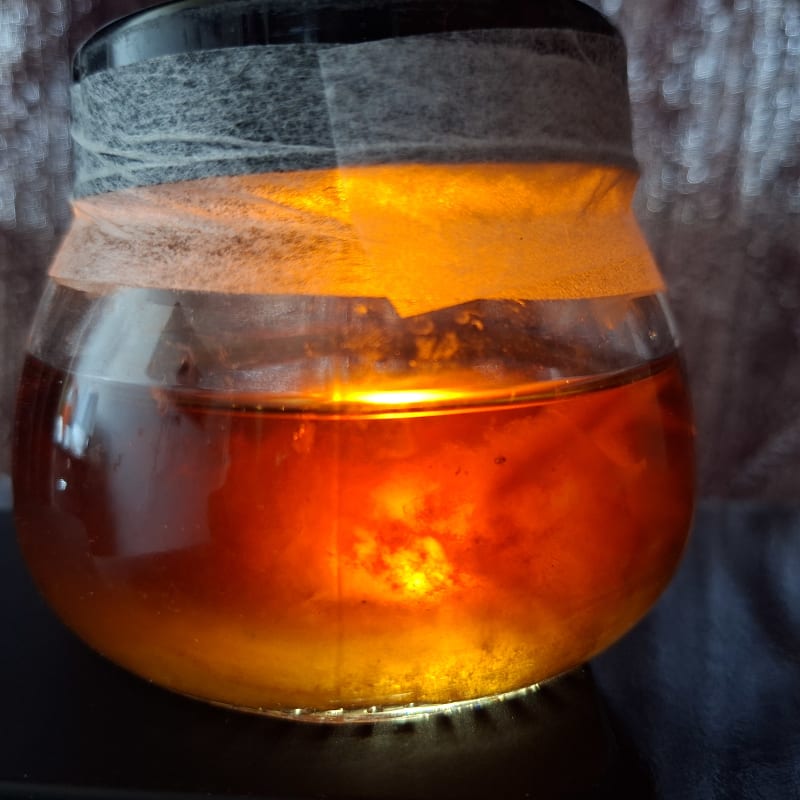
LC-2026-002-J1 — suspended wispy white mycelium in clean amber broth. The first liquid culture to survive its autoclave cycle. |
AGAR-2026-003 — a plate lost to Trichoderma (green mold), isolated and discarded immediately. Failures are part of the trial. |
Full plate and jar status, with every photo, is on /lab.
3. Financials
No ledger entries in May — zero inflow, zero outflow. May's lab work ran entirely on April's purchased stock (media, jars, sterilants), so no new capital was deployed.
| USD | INR | |
|---|---|---|
| Inflow | $0.00 | ₹0.00 |
| Total outflow | $0.00 | ₹0.00 |
| Net change | $0.00 | ₹0.00 |
| Operating balance, 2026-05-31 | $738.58 | ₹68,305.87 |
A flat month on the books is itself the signal: the April equipment buy was front-loaded, and consumables stretched across a second month of batches without a refill. Per-line purchase detail stays private; aggregates are public, and specifics go to existing investors as part of the quarterly audit.
4. Production progress
Zero kilograms harvested in May — expected. The path runs agar → liquid culture → grain spawn → fruiting block, and May is where the liquid-culture step finally cleared. With a clean LC in hand, grain spawn is the next gate.
31 units created in May:
AGAR-2026-002— 10 plates. 9 healthy, 1 contaminated (P1).AGAR-2026-003— 16 plates across the T1–T4 recipe trial. 6 healthy, 6 suspect, 4 contaminated.LC-2026-002— 4 jars. 3 healthy, 1 suspect.MOTHER-2026-001— 1 mother-culture plate (registered, not newly poured).
Across the whole lab, all-time: 25 healthy units, 7 suspect, 8 contaminated.
5. Public proof
- Batches: /lab —
AGAR-2026-002,AGAR-2026-003, andLC-2026-002with full event timelines. - Lineage: /lab/lineage —
MOTHER-2026-001→AGAR-2026-001→ the agar wedges that inoculatedLC-2026-002. - Ledger: /ledger — every transaction to date. May adds none.
6. Risks and failures
1. AGAR-2026-003 ran with confounded sterility. The 16-plate media trial was poured under time pressure, so the 4 contaminated and 6 suspect plates can't be cleanly blamed on any one recipe — pour-side handling is a likely shared cause. That doesn't sink the trial: it's judged on which recipe's mycelium reaches farthest toward the edge at 30 days, and the contaminated plates simply drop out of the running. The winner gets finalized as the standard recipe. Cost: ~$1 in media, no equipment.
2. AGAR-2026-002-P1 lost to green mold. May 16, the one plate of ten that didn't hold. Discarded. Cost: ~$0.50 in media.
LC-2026-002-J2 is logged suspect, not a failure: the broth is too dark to read by photo (the image was lit by a torch held under the jar, which is not a usable diagnostic). It goes to grain spawn alongside the other three — the spawn jars themselves will show whether it was clean.
7. Next month (June)
June is about one question: can we get any sample cordyceps fruiting at all.
- Take all four
LC-2026-002jars to grain spawn — the first time the lineage leaves liquid culture — and run that spawn toward a first fruiting. Even a small sample harvest is the goal; the point is to learn whether the full chain works. - Finalize the
AGAR-2026-003recipe: whichever plate's mycelium reaches farthest toward the edge at 30 days is the recipe we standardize on, and the next agar batch (AGAR-2026-004) is poured from it. AGAR-2026-004waits until we have grain spawn fruiting from the LC. No new agar batch until the spawn-to-fruiting step has proven out — there's no point scaling media before the back half of the chain works.
8. Decision log
- 2026-05-26 — LC sterilization is pressure-verified, not timer-based. The April failure was an autoclave that didn't hold sterility on a mechanical timer; from here every cycle is run to a confirmed 15 PSI and visually checked mid-cycle.
- 2026-05-26 — Sterilization holds are kept short for pre-heated broth (~20–25 min at 15 PSI) to avoid sugar degradation, with an overnight in-autoclave cooldown for slow pressure equalisation.
- 2026-05-27 — Media trials move to one nutrient profile per jar/plate with a control, so colonisation speed and contamination resistance can be read per recipe instead of as batch-wide noise.
- 2026-05-31 — LC contamination calls require smell + microscopy, never a photo. The broth is too dark to read by camera — a torch held under the jar is a lighting artifact, not a diagnostic; a suspect jar stays suspect until physically checked.
Questions or corrections → Telegram.